Fewer than 60,000 people – 0.001% of
the world’s population – control three times as much wealth as the entire
bottom half of humanity, according to a report that argues global inequality
has reached such extremes that urgent action has become essential.
The authoritative World Inequality Report
2026,
based on data compiled by 200
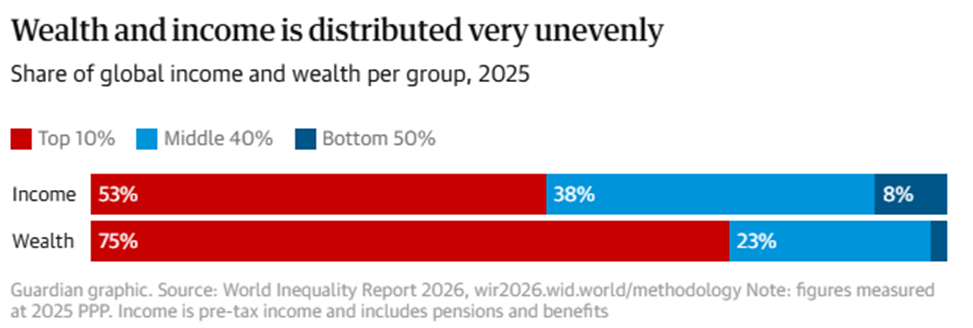
researchers, also found that the top 10% of income-earners earn more than the
other 90% combined, while the poorest half captures less than 10% of total
global earnings.
Wealth – the value of people’s assets
– was even more concentrated than income, or earnings from work and
investments, the report found, with the richest 10% of the world’s population
owning 75% of wealth and the bottom half just 2%.
In almost every region, the top 1% was
wealthier than the bottom 90% combined, the report found, with wealth
inequality increasing rapidly around the world.
“The result is a world in which a tiny
minority commands unprecedented financial power, while billions remain excluded
from even basic economic stability,” the authors, led by Ricardo Gómez-Carrera
of the Paris School of Economics, wrote.
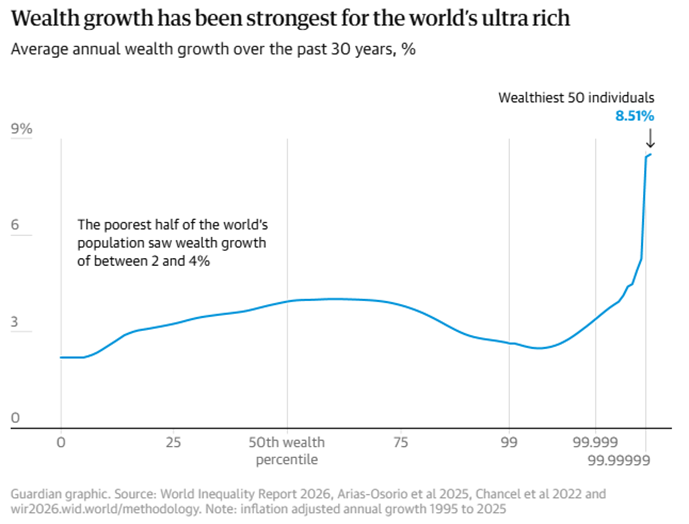
The share of global wealth held by the
top 0.001% has grown from almost 4% in 1995 to more than 6%, the report said,
while the wealth of multimillionaires had increased by about 8% annually since
the 1990s – nearly twice the rate of the bottom 50%.
The authors, one of whom is the
influential French economist Thomas Piketty, said that while inequality had
“long been a defining feature of the global economy”, by 2025 it had “reached
levels that demand urgent attention”.
Reducing inequality was “not only
about fairness, but essential for the resilience of economies, the stability of
democracies, and the viability of our planet”. They said such extreme divides
are no longer sustainable for societies or ecosystems.
Produced every four years in
conjunction with the United Nations Development Programme, the report draws on
the biggest open-access database on global economic inequality and is widely
considered to shape international public debate on the issue.
In a preface, the Nobel prize-winning
economist Joseph
Stiglitz repeated a call for an international panel comparable
to the UN’s IPCC on climate change, to “track inequality worldwide and provide objective,
evidence-based recommendations”.
Looking beyond strict economic inequality, it found that inequality of opportunity fuels inequality of outcomes, with education spending per child in Europe and North America, for example, more than 40 times that in sub-Saharan Africa – a gap roughly three times greater than GDP per capita.
Such disparities “entrench a geography of opportunity”, it said, adding that a 3% global tax on fewer than 100,000 centimillionaires and billionaires would raise $750bn a year – the education budget of low and middle-income countries.
Inequality was also fuelled by the
global financial system, which is rigged in favour of rich countries, the
report said, with advanced economies able to borrow cheaply and invest abroad
at higher returns, allowing them to act as “financial rentiers”.
About 1% of global GDP flows from
poorer to richer countries each year through net income transfers associated
with high yields and low interest payments on rich-country liabilities, it said
– almost three times the amount of global development aid.
On gender inequality, the report said a gender pay gap “persists across all regions”. Excluding unpaid work, women
earn on average only 61% of what men earn per working hour. Including unpaid
labour, that figure falls to just 32%, it added.
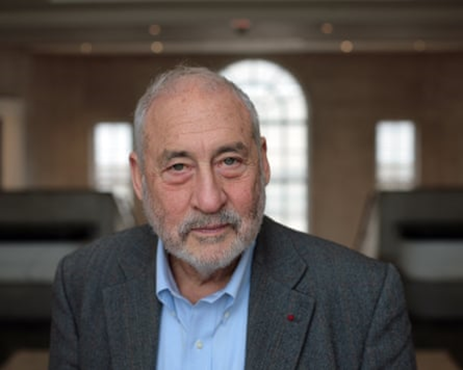
Nobel prize-winning economist Joseph Stiglitz, in a preface to
the report,
called for an international panel to track global inequality.
The report also highlighted the
critical role played by capital ownership in the inequality of climate-changing
carbon emissions. “Wealthy individuals fuel the climate crisis through their
investments even more than their consumption and lifestyles,” it said.
Global data shows the poorest half of
the global population accounts for only 3% of carbon emissions associated with
private capital ownership, the report calculated, while the wealthiest 10%
account for about 77% of emissions.
“This
disparity is about vulnerability,” it said. “Those who emit the least, largely
populations in low-income countries, are also those most exposed to climate
shocks. Those who emit the most are more insulated against the impacts of
climate change.”
The evidence shows
that inequalities can be reduced, particularly by public investment in
education and health and by effective taxation and redistribution programmes.
It notes that in many countries, the ultra-rich escape taxation.
“Effective income
tax rates climb steadily for most of the population, but then fall sharply for
billionaires and centimillionaires,” the report said. Proportionately, “these
elites pay less than most of the households that earn much lower incomes”.
Reducing inequality is a political choice made more difficult by “fragmented electorates, under-representation of workers, and the outsized influence of wealth”, it concluded. “The tools exist. The challenge is political will.”
(Sumber : Inequality 2025)